
Bible Concepts

Justification and Sanctification
Out of His unbounding love for the believer, God forgives all sins and credits the righteousness of Christ to that person. The believer is thereby released from the penalty of sin and is adopted into God's family. He has peace with God and a hope for the future.
Justification is critical, in that it provides a way for God to have a relationship with sinful people. It gives believers security, including freedom from guilt and future punishment. While it is necessary for a person to accept the atoning work of Jesus by faith in order to be justified, it is important to note that justification itself is purely an act of God. Important Bible verses about justification include: Romans 3:23-25, Romans 4:4–8, Romans 5:1, Romans 8:30-31, and Galatians 2:16.
The Westminster Shorter Catechism defines justification as "an act of God’s free grace, wherein he pardoneth all our sins, and accepteth us as righteous in his sight, only for the righteousness of Christ imputed to us, and received by faith alone." So, justification is the deliverance from the penalty of sin that was accomplished by Christ for his people at the Cross of Calvary. As the apostle Paul wrote, "Therefore, as one trespass [Adam’s sin] led to condemnation for all men, so one act of righteousness [by Christ] leads to justification and life for all men" (Rom. 5:18).
Justification is an act of the free grace of God alone toward sinners who are deserving of His eternal wrath (Rom. 3:25; Rom. 6:23). It is a divine act that happens only one time to a believer and, unlike sanctification, it is not a continuing process. As a completed work, it can neither be reversed nor repeated ( Heb. 10:2). Therefore, while Christians may not be equally mature in Christ, they are each equally justified (Acts 13:39). Justification is a forensic act describing the legal standing of a justified person before a holy God (Rom. 5:1). It is like a courtroom declaration of being found not guilty based upon Christ’s righteousness alone and not upon a person's works. Justification is received by faith without works (Rom. 3:20-22; Rom. 4:1-8; Gal. 3:5-12). It is not deserved by the sinner and cannot be earned or merited, since a believer’s faith adds absolutely nothing to what Christ has done for him.
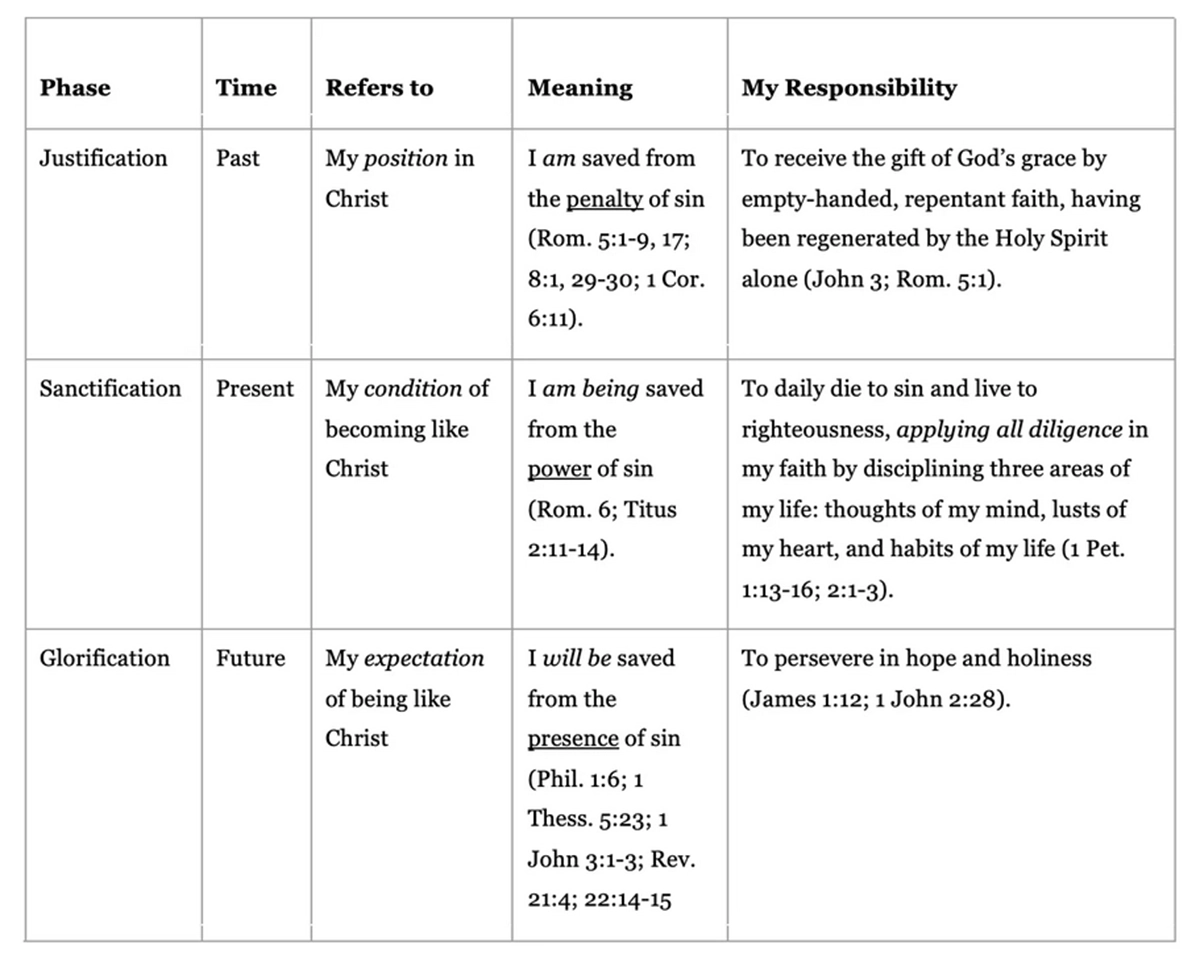
Sanctification is not the act of God declaring a person righteous, but rather, it is the continuous process of believers becoming more Christlike ( Rom. 8:29). It is the continuous, progressive and transforming of our whole person, including our affections, behaviors, thoughts, bodies and wills. Sanctification is both God’s doing and our own. First, it is the Holy Spirit working in his beloved both to will and do of his good pleasure (Phil. 2:13). The Spirit provides continuous deliverance from the power of sin, working in us to live unto righteousness (Phil. 2:12; Gal. 5:22-23), "being confident of this, that He who began a good work in [us] will continue to perfect it until the day of Christ Jesus" (Phil. 1:6).
As to the believer's part, he is to count himself dead to sin, but alive to God and his righteousness (Rom. 6:11). While the power of sin in us is broken, we still have to take active steps against it. We need to not let sin reign in our bodies or offer any part of ourselves to sin (Rom. 6:12-13). Instead, we offer ourselves as willing bond-slaves to righteousness (Rom. 6:22). The Holy Spirit’s goal in the believer’s sanctification is that he will be found in Christ’s image — "so that when he appears we may be confident and unashamed before him at his coming" (1 John 2:28). As Paul says in Romans 8:29-30, "For those whom he foreknew he also predestined to be conformed to the image of his Son, in order that he might be the firstborn among many brothers. And those whom he predestined he also called, and those whom he called he also justified, and those whom he justified he also glorified."
In summary, justification is a declaration of one’s righteousness; sanctification is the process of making one more righteous. Justification is a once-and-for-all divine act; sanctification is a continual process. Both justification and sanctification are different aspects of a believer’s eternal salvation in Christ (Heb. 2:3; Heb. 5:9), and both are graces that lie at the very heart of the gospel.
More on Video See Video 2 See Video 3
Related Studies in the Epistles of Paul (2)
Explore related teachings and studies in the New Testament epistles.


© 2026 AVisitWithJesus
"For God so loved the world, that he gave his only begotten Son,
that whosoever believeth in him should not perish, but have everlasting life."
