
Bible Concepts

Son of God or Son of Man?
Jesus has been worshipped as the Son of God by millions over centuries, but "Son of Man" is the primary title Jesus used when referring to Himself (e.g., Matthew 12:32; 13:37; Luke 12:8; John 1:51). Only Stephen, as he was being martyred, (Acts 7:56), used the same term in reference to Jesus.
The title, "Son of Man" focuses on the humanity of Christ. When God called the prophet Ezekiel “son of man” he was calling Ezekiel a human being, making "Son of Man" a synonym for “human.” Thus, the term also meant that Jesus Christ was truly a human being, and had come “in the flesh” (1 John 4:2). However, Son of Man is also a term suggesting humility. The eternal God took on human flesh, becoming the Son of Man, to be “despised and rejected by mankind” (Isaiah 53:3). He had “no place to lay his head” (Luke 9:58) and "suffered at the hands of men," (Matthew 17:12). This lowering of His status from God to Son of Man represents the most supreme example of humility (Philippians 2:6–8).
Son of Man, however, is also a title of deity. In Him “all the fullness of the Deity lives in bodily form” (Colossians 2:9), enabling the Son of Man to forgive sins (Matthew 9:6) and to be Lord of the Sabbath (Mark 2:28). He came to save lives (Luke 9:56; 19:10), rise from the dead (Mark 9:9), and execute judgment (John 5:27). It was, in fact, Jesus' claim to be the "Son of Man" that proved his undoing when he stood before the high priest at his trial. He declared:
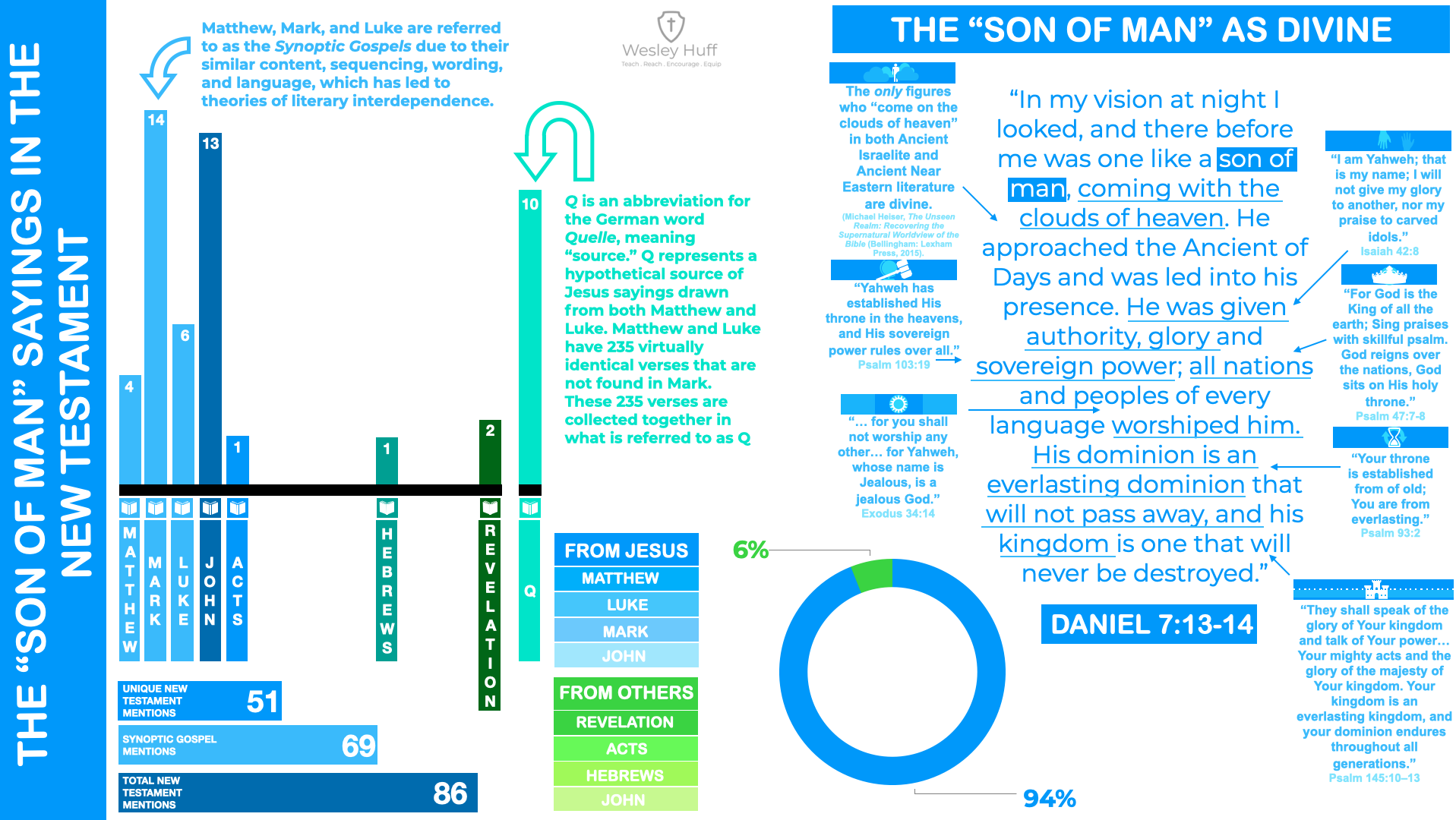
“I say to all of you: From now on you will see the Son of Man sitting at the right hand of the Mighty One and coming on the clouds of heaven” (Matthew 26:64).
This prompted the priest and council to accuse Jesus of blasphemy and to demand his death. But why?
It was because Jesus was claiming to fulfill specific prophecy. His statement was a reference to the prophecy of Daniel 7:13–14:
“I was watching in the night visions, And behold, One like the Son of Man, Coming with the clouds of heaven! He came to the Ancient of Days, And they brought Him near before Him. Then to Him was given dominion and glory and a kingdom, That all peoples, nations, and languages should serve Him. His dominion is an everlasting dominion, Which shall not pass away, And His kingdom the one Which shall not be destroyed”.
What is important here is this. A claim to Messiah-ship was not, in itself, a capital offense, as Messiah was presumed to be an entirely human ruler, and was a role that had been claimed by others before. The "blasphemy" declared by the council related to Jesus' assertion that he would be "seated at the right hand of power." The king's officers could be depicted standing around his throne in ancient artwork, but only his son and equal could he shown "sitting" at his right hand. This was a clear declaration of equality. Similarly, scripture also instructed the rabbis that God alone "comes on the clouds of heaven." Jesus' statement then asserted him to be God's equal, or more precisely, to be God.
We can see, therefore, that the council members were in some sense correct to call this blasphemy. Unless, of course, his statement was true! What they were unable to comprehend was that they were actually in the presence of God.
Related Studies in the Epistles of Paul (1)
Explore related teachings and studies in the New Testament epistles.


© 2026 AVisitWithJesus
"For God so loved the world, that he gave his only begotten Son,
that whosoever believeth in him should not perish, but have everlasting life."
