Fishing on the Sea of Galilee
Fishing was an important occupation around the Sea of Galilee and supported families, markets, processors, and traders throughout the lakeside economy.


The Sea of Galilee was more than a backdrop to the ministry of Jesus. It was a working lake surrounded by towns and villages whose people depended on fishing, farming, trade, and travel. Boats moved across its waters, fishermen worked its shores, and fresh and preserved fish entered the markets of Galilee and beyond.
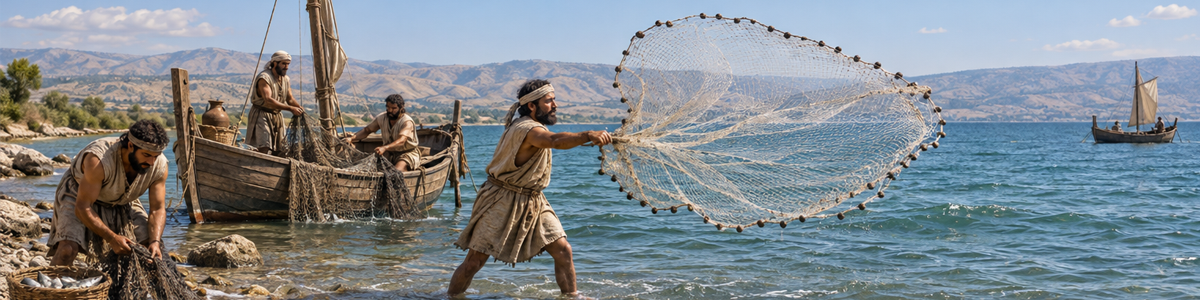
Several of Jesus' first disciples were fishermen. When the Gospels speak of casting nets, mending them, working through the night, sorting a catch, or crossing the lake by boat, they describe activities that belonged to everyday life around the Sea of Galilee.
Fishing on the Sea of Galilee required skill, equipment, cooperation, and knowledge of the lake. Fishermen used several methods, including casting nets, larger nets worked by crews, and hook and line. Boats made it possible to reach fishing grounds and transport people and catches along the shore.
Fishing also supported a wider economy. Boat builders, net makers, hired workers, fish processors, merchants, carriers, and market sellers could all participate in the chain that brought fish from the lake to consumers. Magdala became particularly associated with fish processing and trade.
Archaeology, ancient texts, and the Gospels together show that fishing was an important part of life around the Sea of Galilee during the Roman period. Archaeological finds include fishing equipment, harbor remains, and an Early Roman workboat recovered near Ginosar. Ancient writers describe the lake and its fish, while archaeological work at Magdala provides evidence for substantial commercial activity associated with the lakeshore economy.
Some details remain uncertain. Scholars continue to debate the precise organization of fishing rights, taxation, and processing industries. Evidence therefore supports a substantial fishing economy without allowing every part of its administration to be reconstructed with certainty.
The Sea of Galilee occupies a central place in the Gospel accounts of Jesus' ministry. Simon Peter, Andrew, James, and John were fishermen. The Gospels describe casting nets, mending and washing nets, fishing at night, working with partners, and traveling by boat. Jesus taught from a boat, calmed storms on the lake, provided miraculous catches of fish, and used fishing as an image for gathering people into God's kingdom.
Understanding the practical world of Galilean fishing helps these scenes become more concrete. Nets represented valuable equipment, boats required investment and maintenance, and a successful catch could depend upon the coordinated work of several people.
Fishing connects the Gospel story with ordinary working life. Jesus called disciples while they were engaged in their trade and used familiar fishing experiences to teach spiritual truths. Knowing how fishermen worked, how catches were handled, and how lakeside communities depended upon the fishing economy helps modern readers see that these Gospel scenes took place in a real economic and social world.


Some men earned their living by working for other people rather than from their own land or workshop. Hired labor could provide needed income, but work was not always guaranteed. A laborer's household could therefore be economically vulnerable.

Food had to last beyond the moment of harvest or preparation. Drying, salting, processing, and careful storage helped households preserve foods and maintain supplies when fresh produce was unavailable.
Fish formed an important part of the food economy in some parts of Roman Palestine, especially around the Sea of Galilee. Fish could be eaten fresh near the place of catch, while processing and preservation allowed it to travel farther.

Merchants and traders connected producers with consumers. They moved agricultural products, manufactured goods, raw materials, and other commodities between villages, towns, cities, ports, and regions.
© 2026 AVisitWithJesus
"For God so loved the world, that he gave his only begotten Son,
that whosoever believeth in him should not perish, but have everlasting life."
