

Luke's family members were Greeks of Antioch in Syria, where he was probably born in about 17 B.C.. His name is the Hellenized form of the common Roman name, Lucanus, and it is possible that his father was the freed slave of a Roman family. Slavery did not have the same meaning then that it does now, and it is possible that his education was very advanced.
Part of that education may have been rabbinical, as he appears to have been versed in the Law and the Prophets. Also, it seems that his command of Greek surpassed that of the other Gospel writers. As a result, he was able to write like a Jew when discussing the Law or the songs of Simeon and of Mary, while also able to write as an erudite Greek when relating content unrelated to scripture. Interestingly, his style is that of the written word, while the other Gospels have the character of speech. This makes sense, since the other writers were not lettered men, but carried on mostly in oral tradition.
Luke may have obtained his medical education in Tarsus, one of the top educational centers of the Mediterranean world. Perhaps he first met Saul there, for Saul was a native of the town, and a Roman citizen by birth . Tradition indicates that Luke first practiced at Antioch, and he tells us that it was there that the disciples were "first called Christians." In this city he may have come under the influence of the converted Paul, soon joining him and setting out in the fall of the year 50 to meet Paul at Troas.
There, Luke's journeys began as "the beloved physician." At that point in the Acts narrative, it is important to note that the account changes from an impersonal fact recital (employing the pronoun, "they") to a diary of a companion and eyewitness (using the pronoun, " we " ). They traveled to Philippi, "the chief city of that part of Macedonia and a (Roman) colony," and Luke stayed while Paul went on to preach in Athens, Corinth and Ephesus. When negative feelings towards Paul surfaced in the Palestinian Church, Paul decided to go to Jerusalem to confront these. He disregarded warnings of persecution and set sail with Luke in their first long journey together.
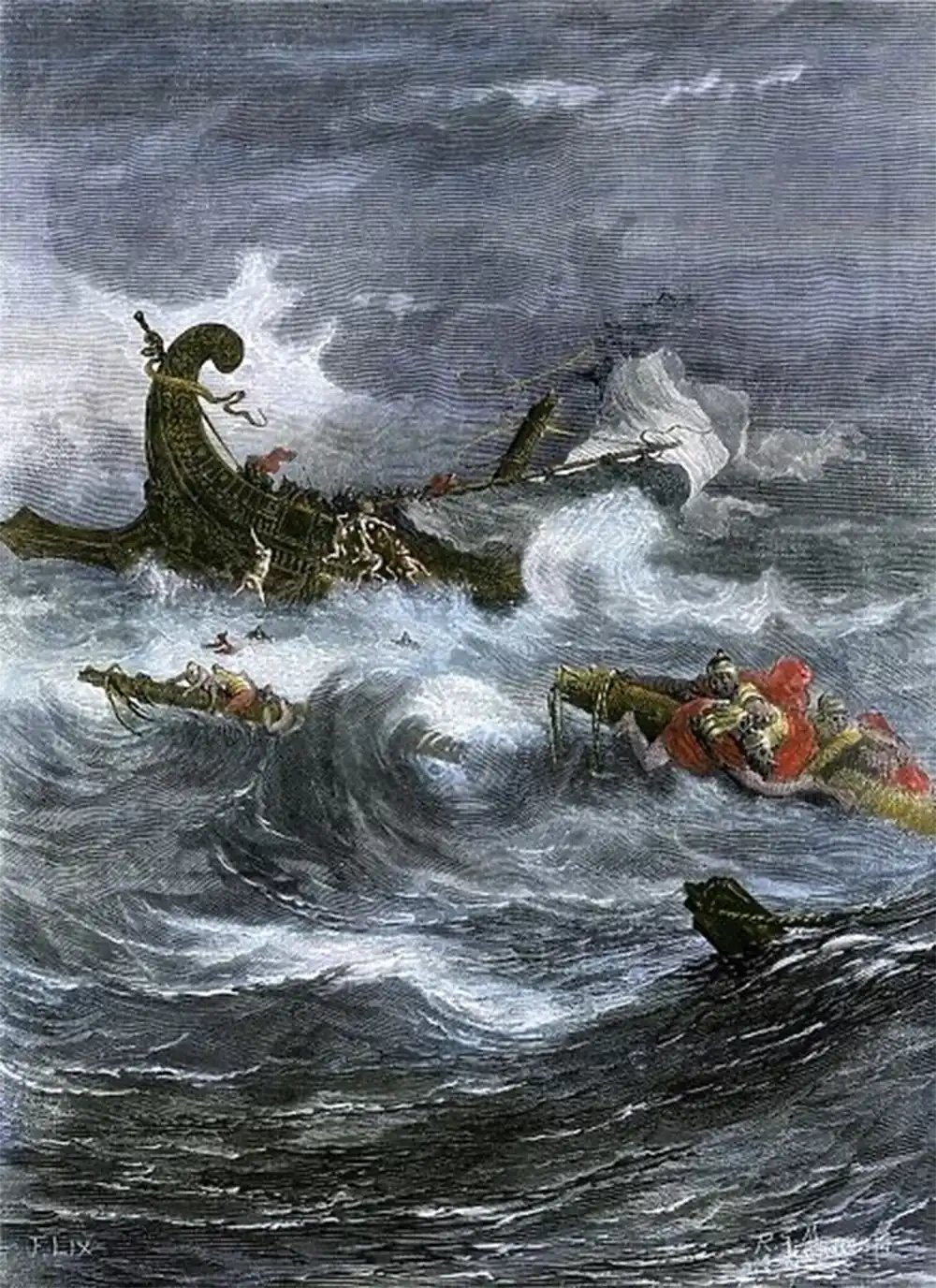
Luke's next long journey began with Paul's imprisonment and his trials, which resulted in his appeal to Caesar. Paul and Luke set out for Rome under guard and were shipwrecked on the island of Malta. His account ends about two years after their arrival in Rome, where St. Paul was still awaiting his trial. It may have been there that he wrote his books.
St. Paul was condemned and executed a few miles from Rome at a location on the Ostian Way called Tres Tabernae. A short time before that he had written from prison that "only Luke is with me." Following Paul's death, Luke's activities become more obscure, with tradition suggesting that he died at the age of 84 in Bithynia on the Asiatic shore of the Black Sea. St. Jerome states that his bones, with those of the apostle Andrew, were buried in Constantinople.
The length of a book in Luke's time was limited by the dimensions of a manuscript roll. His two books are brief, even though they contain more than one third of the New Testament. The canonical arrangement interposes the Gospel of St. John between Luke's books, which were intended as volumes in a single work. The books are clearly intended for general use, so that Theophilus, to whom they are dedicated, was probably not a person but a pun (Theophilus meaning lover of God). The abrupt ending with St. Paul still "preaching the kingdom of God" suggests that a third volume was planned. Since it is unlikely that it was written and lost, it may be that Luke was so outraged by the fatal judgment of Nero's court in the case of his friend and patient, that he didn't have the heart to continue.
That St. Luke was a physician and that he even existed, was questioned and denied with the advent of 19 century skepticism. Such viewpoints are easily challenged for Paul himself called him "the beloved physician." The other evidences are many and cumulative. What may be a clinching argument is the occasional use of medical words in a nonmedical sense; for example, when he tells of the strengthening of the ship during the storm, he uses a word which means splinting, as in surgery.
As we observed, Luke was a devoted, learned man and physician who left his profession but never forsook it. St. Jerome said that "Luke the physician by leaving to the Churches his Gospel and the Acts of the Apostles, has shown us how the Apostles became from fishers of fish, fishers of man; for he himself became from a physician of the body, a physician of the soul . . . and as often as his Book is read in the Church, so often does his medicine flow out."


