

The apostle and evangelist Mark, also known as John Mark (Acts 12:12), was a nephew of Barnabas. While some believe him to have been born at Jerusalem, others propose that he was born in Cyrene, the child of a Greek man and a Jewish woman. The house of his mother Mary may have been the location of the Last Supper and Church tradition suggests that on the night that Christ was betrayed, Mark followed Him, wrapped only in a linen cloth. When he was seized by soldiers, he ran away naked, leaving the cloth behind (Mark 14:51-52). After the Ascension of the Lord, the house of his mother Mary became a place where Christians gathered, and a place of lodging for some of the Apostles. When Saint Peter escaped from prison, he went to the home of Mark’s mother.
Mark was at Seleucia with Paul and Barnabas, and from there he set off to the island of Cyprus, which he traversed east to west. In the city of Paphos, he witnessed the blinding of the sorcerer Elymas by Paul (Acts 13:6-12). When they reached Pamphylia, Mark decided to return alone to Jerusalem, angering Paul. This is evident from Paul’s refusal to let Mark accompany him on the second journey despite Barnabas’s insistence. Because Paul later asks Mark to visit him in prison, it is surmised that the trouble between them did not persist.
After he returned to Jerusalem, he went to Rome with the Apostle Peter. From there, he set out for Egypt, where he established a local Church.
Later he met Paul again in Antioch, from which city he traveled with Barnabas to Cyprus. After returning to Egypt, he and Peter founded other churches before traveling to Babylon. It was there that Peter wrote an epistle to the Christians of Asia Minor in which he called Mark his son (1 Peter 5:13). Some traditions propose that Mark was a great help to Peter, functioning as his translator as he moved throughout of the Greek speaking Roman Empire.
When the Apostle Paul went to Rome in chains, Saint Mark was at Ephesus, where Timothy was bishop. The two went to Rome where he may have written his Gospel in about AD 62-63. From Rome, Mark traveled to Alexandria where he started a Christian school, (which school later produced famous teachers of the Church such as Clement of Alexandria and Dionysius of Alexandria). Mark went on to preach the Gospel in the inner regions of Africa, and he was in Libya at Nektopolis.
Back in Alexandria, Marks success in prostletyzing roused the anger of the pagans, and they wanted to kill Saint Mark. Having learned of this, Mark made Ananias a bishop, and Malchos, Sabinos, and Kerdinos were ordained presbyters to provide the church with leadership after his death. The pagans seized Mark when he was preaching. They beat him, dragged him through the streets and threw him in prison. On the following day, the angry crowd again dragged the saint through the streets to the courtroom, but along the way Saint Mark died saying, “Into Your hands, O Lord, I commend my spirit.”
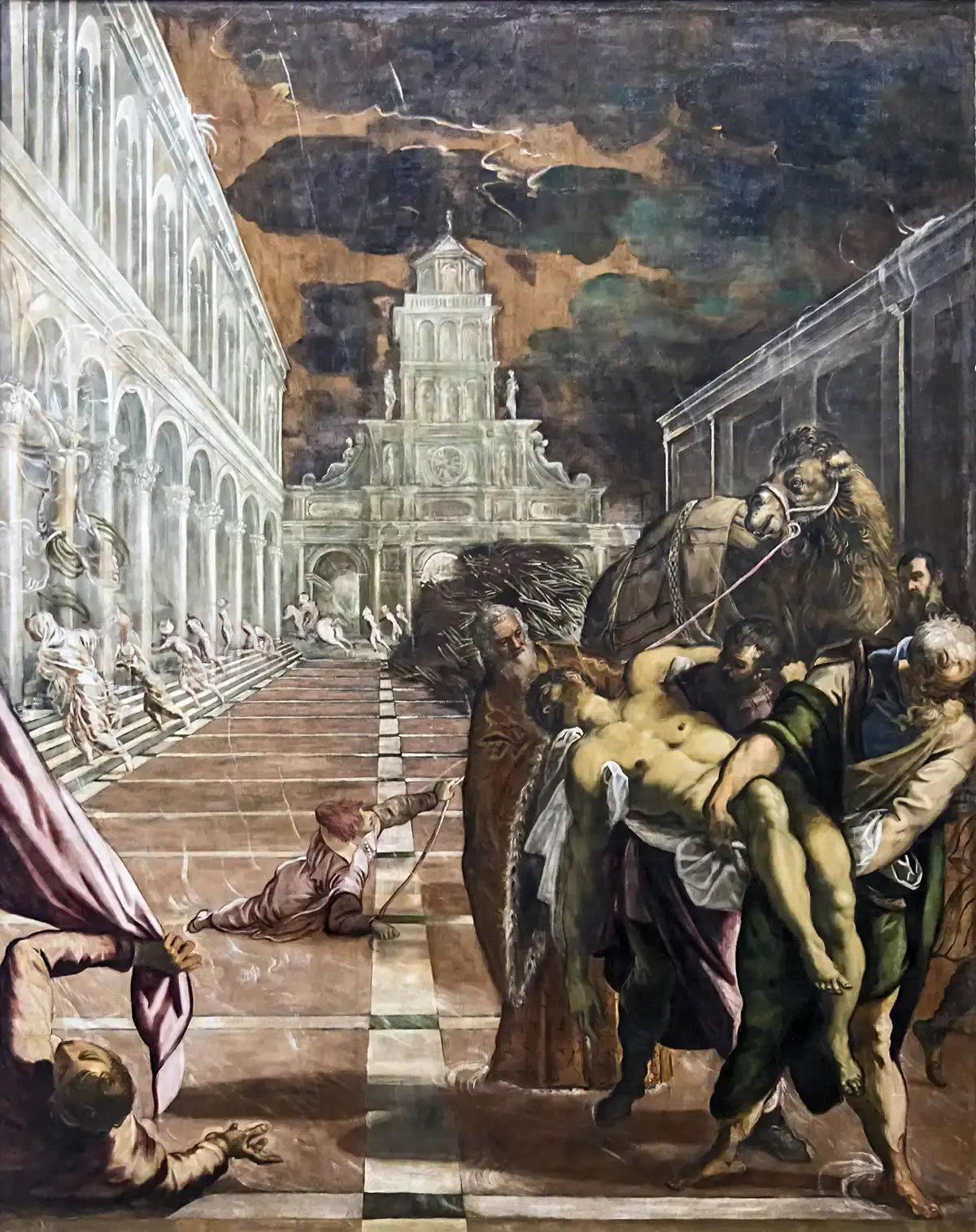
Christians took up the body of Saint Mark and buried it in a stone crypt. In the year 310, a church was built over the relics of Mark. In 820, when the Moslem Arabs had come to rule in Egypt and oppressed the Christian Church, the relics of Mark were transferred to Venice and placed in the church named for him.


