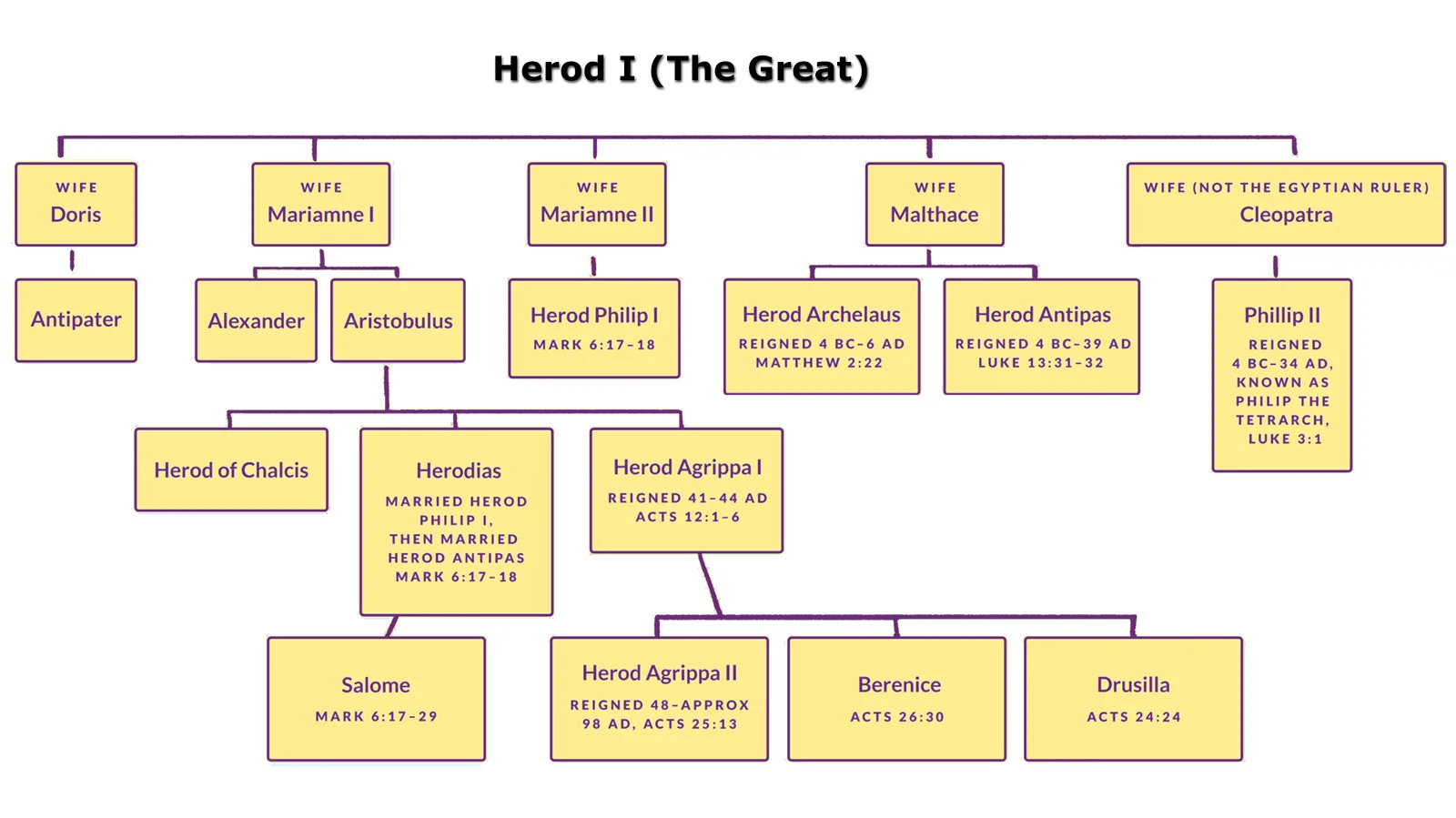
One Salome in the Gospels was actually the mother of Zebedee's sons, James and John. She was a follower of Jesus and his apostles, and was present at both Golgatha and the tomb three days later. The other Salome is not named in the New Testament, but we are able to glean her name from the family history of her mother, Herodias.
Herodias had been married to her uncle, Herod Philip, and with him had a daughter named Salome. Heroidias subsequently divorced this husband and married another uncle, Herod Antipas, whom she thought had a greater chance of gaining the throne in Israel. It was for Antipas that the "daughter of Herodias" danced, and this dancer assisted her mother in obtaining a death sentence for John the Baptist.
Josephus states that Salome was herself, twice married, first to the tetrarch Philip (a half brother of her father, Herod Philip, and a son of Herod I the Great) and then to Aristobulus (son of Herod of Chalcis). She is not to be confused with Salome, sister of Herod I the Great.
From this evil Salome’s story, we learn about the dangers of sin and promiscuity. A chain of immoral decisions led to the death of John the Baptist who was a preacher of God’s Word. The story begins with greed for power and position in the heart of Herodias. With Herod, she was involved in an illegal marriage and betrayed his brother, Philip. When she heard the truth from John the Baptist, she wanted to get rid of him and his message to keep her place as queen. She used her very own daughter to get what she wanted from Herod—John silenced forever.
From these verses in Matthew, we learn that decisions aren’t limited to affecting individuals. Herodias’s greed caused her daughter’s promiscuity and Herod’s murderous command. Sin can become a web of entanglement, trapping many along the way. A desire for prestige and power resulted in the death of a good and faithful man.