Gospel Figure

Pontius Pilate

A Visit With Jesus

At a Glance

Name
Pontius Pilate

Pontius Pilate was the Roman prefect (governor) of Judea, a subprovince of Syria, who ordered the crucifixion of Jesus. As prefect, Pilate commanded Roman military units, authorized construction projects, arranged for the collection of imperial taxes, and decided civil and criminal cases. 

Biography

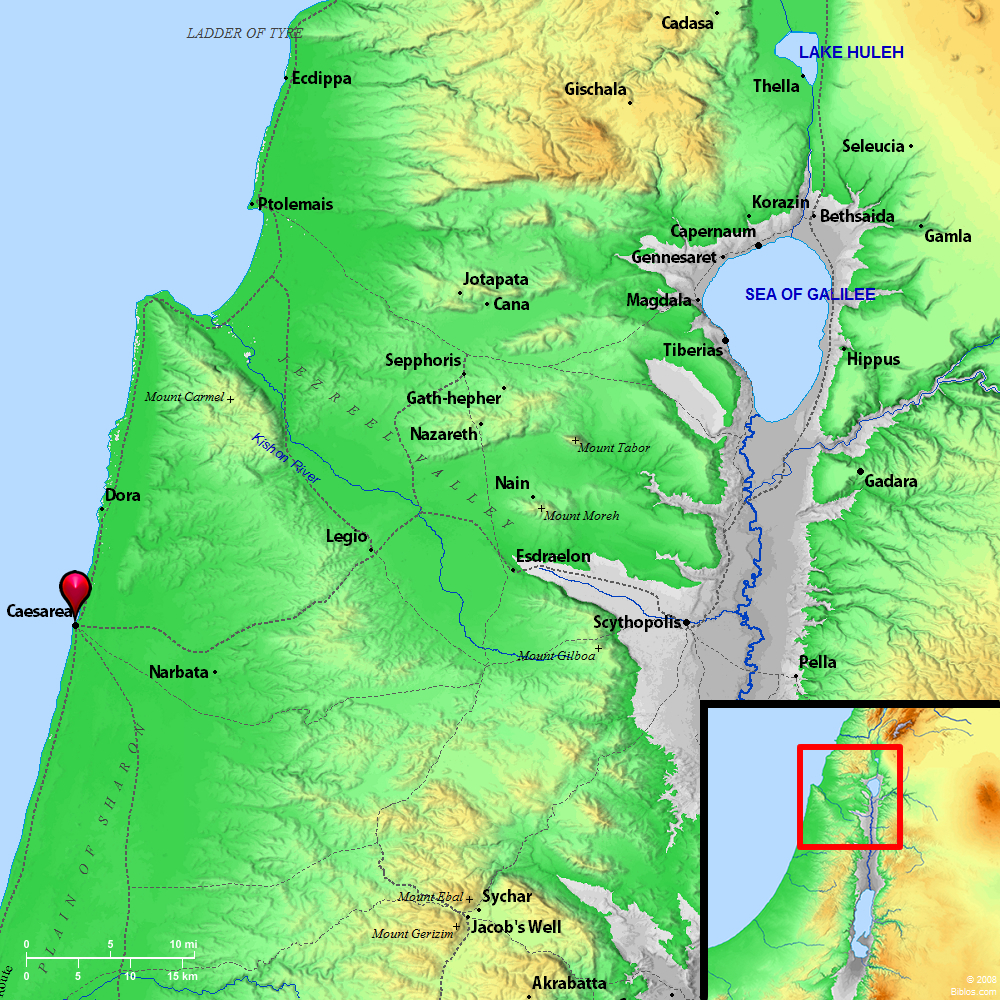
During his ten-year tenure as prefect, Pilate had numerous confrontations with the Jewish people.  According to Jewish historian Josephus, Pilate's decision to bring into the holy city of Jerusalem "by night and under cover effigies of Caesar" outraged Jews who considered the images idolatrous.  Jews carried their protest to Pilate's base in Caesaria.  Pilate threatened the protesters with death, but when they appeared willing to accept martyrdom he relented and removed the offending images.  Also from Josephus we learn that Pilate provoked a different outcry from his Jewish subjects when he used Temple funds to build an aqueduct. 

According to Philo writing in 41 A.D., Pilate's lack of concern for Jewish sensibilities was accompanied by corruption and brutality.  Philo wrote that Pilate's tenure was associated with "briberies, insults, robberies, outrages, wanton injustices, constantly repeated executions without trial, and ceaseless and grievous cruelty."  Philo may have overstated the case, but there is little to suggest that Pilate would have any serious reservations about executing a Jewish rabble-rouser such as Jesus.
Although Pilate spent most of his time in the coastal town of Caesaria, he traveled to Jerusalem for important Jewish festivals.  While in Jerusalem, he stayed in what was called the praetorium. This was either a former palace of Herod the Great or the Antonia fortress located at the northwest corner of the Temple Mount.  Josephus believed that Pilate resided at the palace.

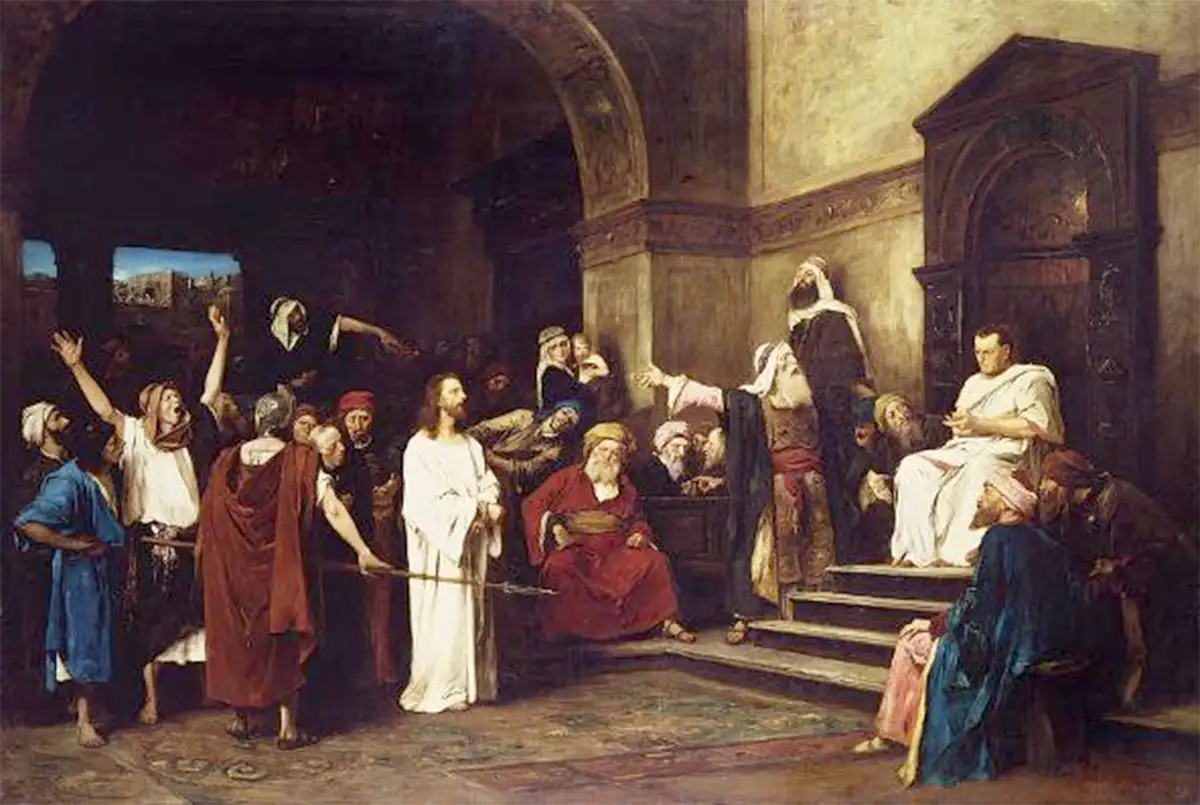
Gospel accounts of the trial of Jesus suggest that Pilate either played no direct role in the decision to execute Jesus, or that he ordered the crucifixion of Jesus with some reluctance (Mark, Luke, and John).  Some historians believe these accounts were created as Christian efforts to make their message more palatable to Roman audiences.  Prefects had a variety of options available for dealing with potential troublemakers like Jesus,  including flogging, sending the matter back to the Sanhedrin, or referring the case to Herod Antipas, ruler of Galilee.

Given what is known about Pilate's concern with crowd control, it is unlikely that he would not quickly agree to a request from high Jewish officials to deal harshly with someone claiming to be "King of the Jews."  He knew that past messianic claims had led to civil unrest, so he may have been eager to end the potential threat to the existing order. The use of crucifixion establishes that Jesus was condemned as a violator of Roman, not Jewish, law.

Pilate's repeated difficulties with his Jewish subjects was the apparent cause of his removal from office in 36 C.E. by Syrian governor Vitellius.  Following his removal from office, Pilate was ordered to Rome to face complaints of excessive cruelty.  From there, he was exiled in Vienne, France.

Artist Renderings

Historical Evidence and Sources

Tacitus, Annals 15:44, in The Annals: The Reigns of Tiberius, Claudius, and Nero (trans. J. C. Yardley; introduction and notes Anthony A. Barrett; Oxford World’s Classics; New York: Oxford Univ. Press, 2008), p. 438. Cornelius Tacitus (c. 55‒c. 118 C.E.) was a historian, a Roman senator and a member of the priestly organization that supervised foreign religions in Rome; therefore he had exceptional access to information known by his colleagues and to archives accessible to the elite.

Philo, De Legatione ad Gaium 38, in The Works of Philo, Complete and Unabridged (trans. C. D. Yonge; new updated ed.; Peabody, MA: Hendrickson, 1993), p. 784. Philo Judaeus of Alexandria (c. 20 B.C.E.‒c. 50 C.E.) was Pilate’s learned contemporary.

The “Pilate Stone” was discovered at Caesarea Maritima in 1961 in the theater or arena of the ancient city of Caesarea Maritima, on Israel’s northern seacoast. This limestone block—2.7 feet high, 2 feet wide and 0.6 feet thick—was lying face down and had been used as a step. It had been trimmed down to be reused twice. Two of its four lines read, in English translation with square brackets marking missing portions that have been supplied by scholars: “[Po]ntius Pilate … [Pref]ect of Juda[ea],” as shown in Inscriptions Caesarea Maritima, pp. 67–70, no. 43, Plate XXXVI. The inscription could potentially be dated to any time in Pilate’s career, but a date between 31 and 36 C.E. seems most likely (Inscriptions Caesarea Maritima, p. 70.). The word for the building dedicated to the emperor Tiberius, “Tiberieum,” is in the first line of writing (on the line above it is only a mark resembling an apostrophe). On the second line of writing are the last four letters of the family name Pontius, which was common in central and northern Italy during that era. Still visible, clearly engraved in the stone, is the complete name Pilatus, which is translated into English as “Pilate.” Pilatus was “extremely rare” (A. N. Sherwin-White, “Pilate, Pontius,” in ISBE, vol. 3, p. 867). Because of the rarity of the name Pilatus, and because only one Pontius Pilatus was ever the Roman governor of Judea, this identification should be regarded as completely certain and redundantly assured.

Coins:
As with other Roman governors, the coins Pilate issued do not have his name on them, but rather display only the name of the Roman emperor, in this case Tiberius. Pilate’s coins also display his distinctive decorations.
At Masada, 123 of Pontius Pilate’s coins were discovered, according to Coins of Masada, pp. 72, 79, pp. 96–97 no. 851–973a, Plate 64 no. 851–912, Plate 65 no. 913–930.
At Caesarea Maritima, 1 of his coins was discovered, according to Coins Caesarea Maritima, p. 139 no. 6, p. 146.
At Herodium, 1 of his coins was discovered, according to Coins Herodium, p. 75 no. 3.

Videos