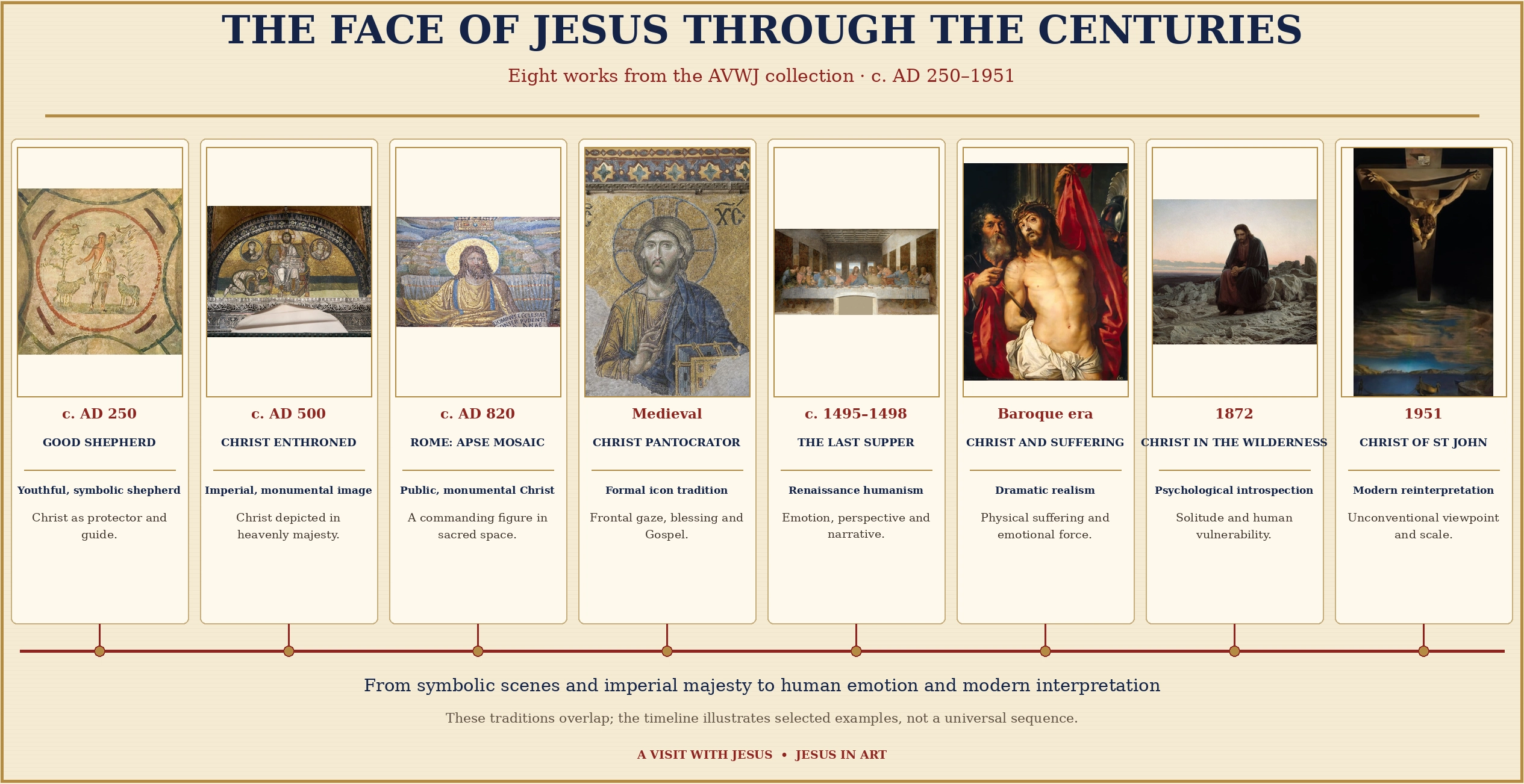
The Face of Jesus Through the Centuries
No contemporary portrait of Jesus is known to survive.
Yet, from the earliest centuries of Christianity, artists
have sought to portray Him through images that express
His teaching, His humanity, His suffering, and His divine authority.
 (Click graphic for full timeline)
These images offer a remarkable journey through Christian history.
The youthful shepherd of the Roman catacombs, the majestic Christ
of Byzantine mosaics, the deeply human figure of Renaissance painting,
and the varied interpretations of modern artists all reflect the
artistic traditions and spiritual concerns of their times.
This exhibition follows those changing depictions through eight
historical periods. Each artwork is accompanied by information
about its origin, creator where known, visual character, and
significance within the history of Christian art.
Explore the Historical Periods
Choose a period to discover its artwork and the history behind it.

c. AD 200-312
The earliest surviving Christian images offer a surprising introduction to the history of Jesus in art. Rather than the familiar long-haired, bearded figure, Christ often appears as a youthful man, sometimes without a beard, dressed in the cloth…

AD 313-600
Following the legalization of Christianity, depictions of Jesus increasingly appeared in monumental churches, mosaics, sarcophagi, and devotional images. Christ could still appear as a youthful shepherd or miracle worker, but artists also portra…

AD 601-1000
In the Byzantine world, the image of Christ developed into one of Christianity's most enduring visual traditions. Jesus was frequently shown as a mature, bearded figure with long hair, a cross-marked halo, and a solemn gaze. He might hold a Gosp…

AD 1001-1400
Medieval artists portrayed Jesus in several complementary ways: the majestic ruler of the universe, the teacher who blesses his people, and the suffering Savior whose death invites personal reflection. Romanesque sculpture and mosaics often emph…

AD 1401-1600
Renaissance artists brought new attention to the human body, natural space, individual expression, and classical ideals of beauty. Jesus remained the central figure of Christian art, but his appearance could now be rendered with convincing anato…

AD 1601-1800
Seventeenth-century painters often brought Jesus closer to the viewer through dramatic light, ordinary surroundings, and intensely human expressions. In the work of Caravaggio, Rembrandt, Velazquez, and their contemporaries, Christ may appear am…

AD 1801-1900
During the nineteenth century, representations of Jesus circulated more widely than ever through prints, illustrated Bibles, devotional books, and paintings reproduced for homes and churches. Many images presented a gentle, compassionate, long-h…

AD 1901-2000
The twentieth century brought both mass familiarity and remarkable diversity to images of Jesus. Widely reproduced devotional portraits reinforced the conventional bearded, long-haired Western Christ. At the same time, modern artists explored ex…