Herod

Godliness
Historical Scripture
Biography
Herod was a client king of Rome, with a route to the throne that was not a straightforward one. His father, Antipater the Idumaean, made him governor of Galilee in 47 BCE. After the death of his father, there was a turbulent period of in-fighting involving his brother and different Roman factions. In 40 BC the Parthians attacked Palestine and took Jerusalem. Herod's brother committed suicide shortly after being taken captive, leaving Herod to flee to Rome, while Antigonus the Hasmonean was installed as ruler in Jerusalem.
In Rome Herod gained the favor of Octavian and Mark Antony, who persuaded the Senate to pronounce Herod king of Judea. Because of the problem of Antigonus and the Parthians, Mark Antony was sent to the region, which he swiftly cleared of the Parthians. Aided by Roman General Gaius Sosius, Herod retook Jerusalem in 37 BC, and began a long and prosperous 33-year reign as king of Judea.
According to historian Josephus, the early years of Herod's reign involved a rivalry with Cleopatra VII, whose consort was Mark Antony, Herod's patron. Cleopatra took possession of some of the most lucrative parts of Herod's kingdom. When Octavian's victory at Actium ended Antony and Cleopatra's influence, Herod forged a new partnership with Rome's first emperor, Augustus.
Herod's reign was largely a peaceful one, and he was not obliged to pay tribute to Rome. By 30 BC he had control of all the areas that the Hasmoneans and Cleopatra had taken. Between 23 and 20 BC he expanded his realm into northern Galilee. As a gifted administrator, he created a new priestly class (abolishing the hereditary qualification) and a multicultural elite. He also created greater standing for Judea in the Mediterranean world through gifts to Athens and patronage of the Olympic Games.
Building Projects
Once established in his kingdom, Herod embarked on a series of grand building projects, possibly funded by a half-shekel tax payable by each Jew in the Diaspora. The program created employment and stimulated the economy, although it is unclear how much the Jewish population benefitted. While the most famous project was a lavish rebuilding of the temple of Jerusalem, Herod also expanded the city's fortification walls and added a theatre and amphitheater. He improved fortresses at Jericho and Masada, rebuilt Samaria (renaming it Sebaste), and constructed a new harbor on the Mediterranean named for Augstus, (Caesarea Maritima). The most ambitious of Herod's building projects, however, was the Herodium fortress south of Jerusalem.
This fortress, (one of seven built by Herod), is on the Jebel Fureidis mountain on the edge of the Judean desert. This cone-shaped mountain was the perfect location for the fortress that Herod built to commemorate his victory over Antigonus and the Parthians. It provided Herod a place of refuge if his rule were ever challenged. It was created by digging out the peak of the mountain and using the recovered material for the walls. A palace was built within the walls, and he supplied it with water via a system of aqueducts. Completed in 15 BC, the complex included a small town at the base of the mountain that included administrative buildings, gardens, a synagogue, mausoleums, and a large pool.
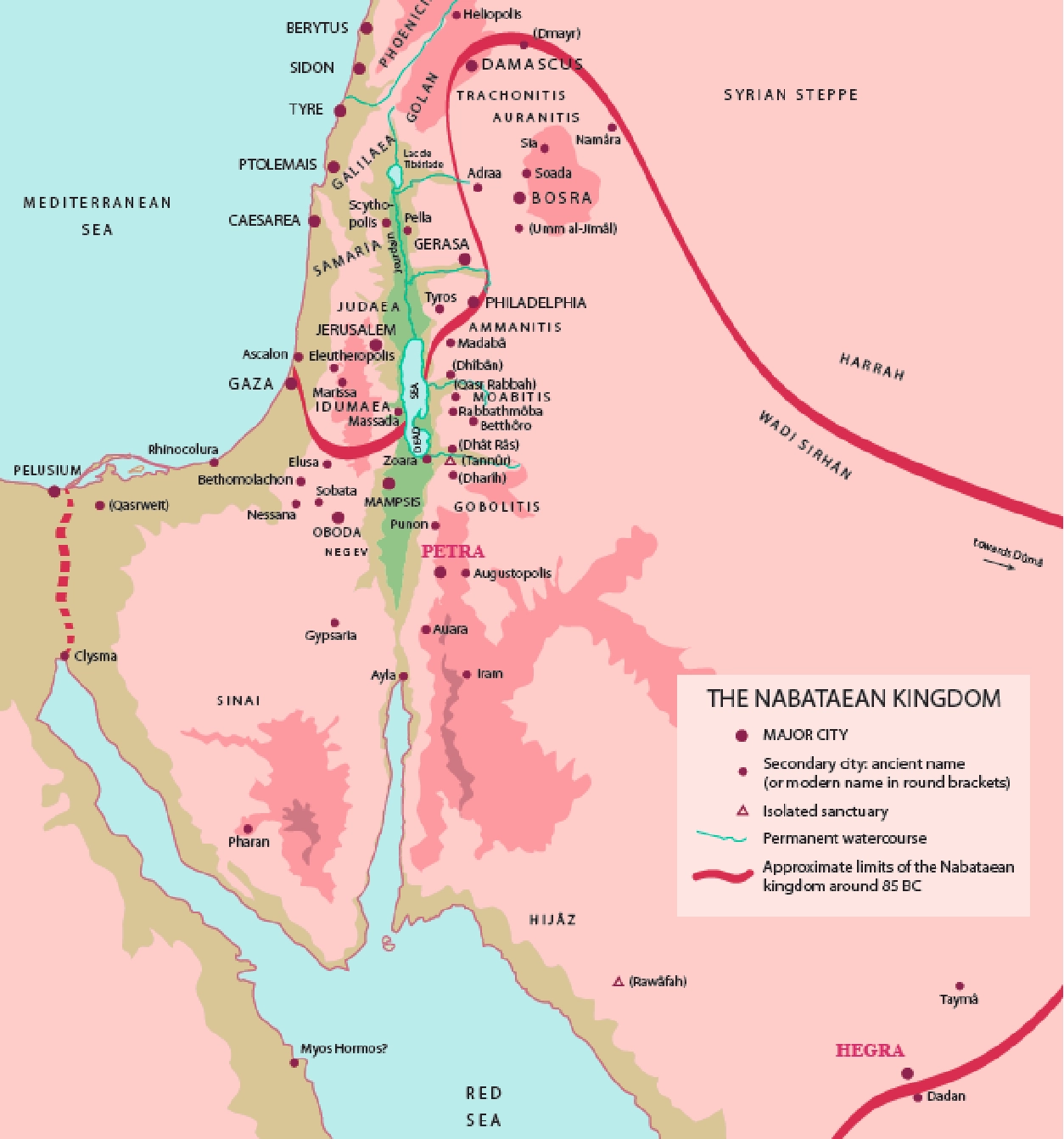
The reign of Herod became more troubled as time went on. A war broke out with Nabataea in 9 BC, and the situation worsened when Augustus initially sided with the Nabataeans in the dispute. Happily for Herod, his envoy to Caesar, Nicolaus of Damascus, was able to convince Augustus to change policy.
Along with such diplomatic problems, Herod had family issues to deal with as well. Suspecting his wife Mariamne of being unfaithful, he had her executed in 29 BC. The two sons he had sired with her were suspected of disloyalty, leading Herod to dispatch them in 6 BC. Two years later, he also killed his eldest son, Antipater. By that time the king was suffering severe health problems and he died in 4 BC. Herod was buried in a purpose-built tomb on the slopes of the Herodium. In 2007 CE this tomb was excavated, but the sarcophagus within it was damaged and empty. Herod's kingdom was divided by the Romans between his three sons: Herod Antipas, Archelaus, and Philip.
Herod's lasting reputation of infamy rests mostly on his depiction in chapter 2 of Mathew in the New Testament. He was threatened by the report of foreign "wise men" that a new "King of the Jews" had been born. When Herod discovered he had been duped by the Magi, who had not reported back after finding the child, "he was exceeding wroth, and sent forth, and slew all the children that were in Bethlehem, and in all the coasts thereof, from two years old and under." (Matthew 2:16).
While some today discount this story as a myth created by Matthew to establish a likeness between Jesus and Moses, many argue that Herod's known brutalities and paranoia make the account all too believable.
Note: The Bible makes mention of "Herod" many times and in many circumstances, potentially leading to confusion between the several men who used this name. In order to avoid confusion between Herod the Great and his various progeny..."