Archelaus

Godliness
Biography
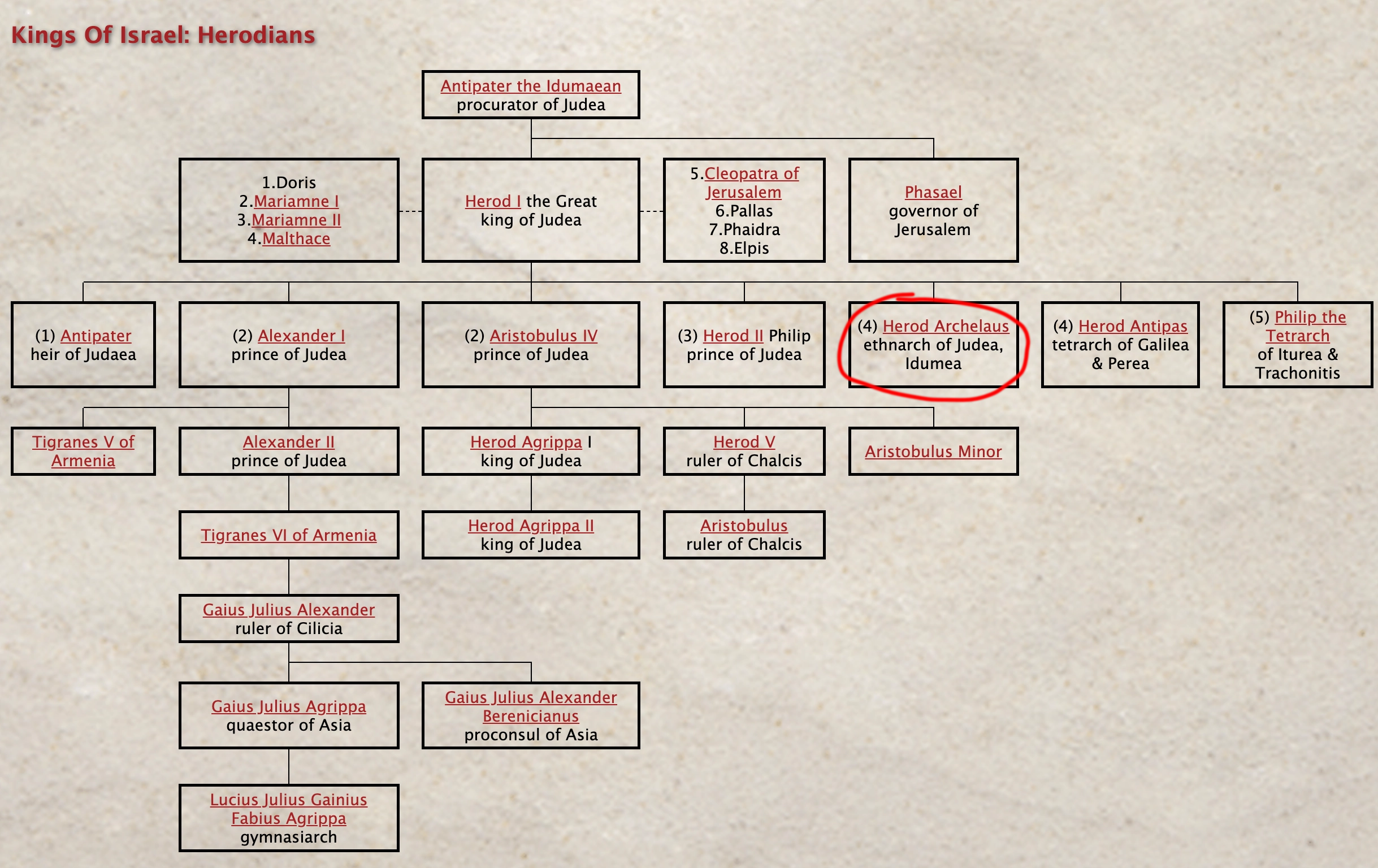
Archelaus was son of Herod I, his mother being the Samaritan Malthace. At the age of fourteen he was sent to Rome for education, and, after a stay of two or three years, returned home with his brothers Antipas and Philip, who had also attended the schools of the Imperial City.
His return may have been hastened by the intrigues of Antipater, who had promulgated slanders against Archelaus, leading Herod I to designate Antipas, his youngest son, as his successor. However, four days before his demise, the king changed his mind and appointed Archelaus to the throne, with Antipas and Philip made tetrarchs of smaller areas. Nothing is known of the reason for this change, although it may have resulted from some palace intrigue.
Archelaus thus attained the crown with little difficulty at the early age of eighteen. The people were glad at the death of his tyrant father, and were well disposed toward Archelaus, who while in the Temple, promised to give regard to his subjects' wishes. However, it some became clear how little he intended to keep his word. The Pharisees demanded the removal of the Sadducean high priest and the punishment of those former councilors of Herod who had brought the martyrdom of the Pharisees Mattathias and Judas. Archelaus, told them he could do nothing before being confirmed by Augustus. The people doubted he would do anything and became so insistent in their demand for immediate action, that the king sent a detachment of soldiers against them into the Temple courts. When this detachment was unable to control the populace, he ordered out the whole garrison and massacred three thousand on the Temple pavements.
Following this, Archelaus rushed to Rome to secure his succession from Augustus. He encountered opposition from two sides. His brother Antipas, claimed formal acknowledgment for Herod's second will, that nominated him king. Also, the Jews of Palestine petitioned for the exclusion of the Herodians from any share whatever in the government, and asked for the incorporation of Judea into the province of Syria. Augustus, considerable insight, concluded that it was better for Roman interests to make Judea a monarchy, governed by its own kings tributary to Rome, and less likely to foment repeated insurrections against the foreign administration. He decided to divide Herod's somewhat extensive empire into three portions. Archelaus was appointed ethnarch—not king—of Judea, Samaria, and Idumea. Antipas and Philip were made tetrarchs of the remaining provinces, the former receiving Galilee and Perea, and the latter the other lands east of the Jordan.
In Palestine, the people broke into open revolt in the absence of a ruler. The actual outbreak was without doubt directly caused by Sabinus—the procurator appointed by Augustus to assume charge pending the settlement of the succession. On the day of Pentecost in the year 4 B.C., a collision took place in the Temple precincts between the troops of Sabinus and the populace. Sabinus utilized his initial success to rob the Temple treasury. Disorders broke out all over the province, and it was only when charge was assumed by Varus, the Roman legate in Syria, that any measure of peace was restored to the land.
Archelaus returned to Jerusalem shortly after Varus suppressed the insurrection. Very little is known of the further events of his 10 year reign, but it would appear that instead of seeking to heal the wounds to the country he had caused, he did much to accelerate the end of Judean independence. In the year 6 AD, the Jewish and Samaritan aristocracy brought charges against Archelaus. He was immediately summoned to Rome, deprived of his crown, and banished to Gaul where he lived for the remainder of his life.
Archelaus was cruel and tyrannical, sensual in the extreme, a hypocrite and a plotter. While he carefully avoided placing his image upon his coinage in deference to pharisaic wishes, he nevertheless married his widowed sister-in-law, Glaphyra, in defiance of the sentiment of the people and the Pharisees, who regarded the union as incestuous.