Wiki Details
See Map
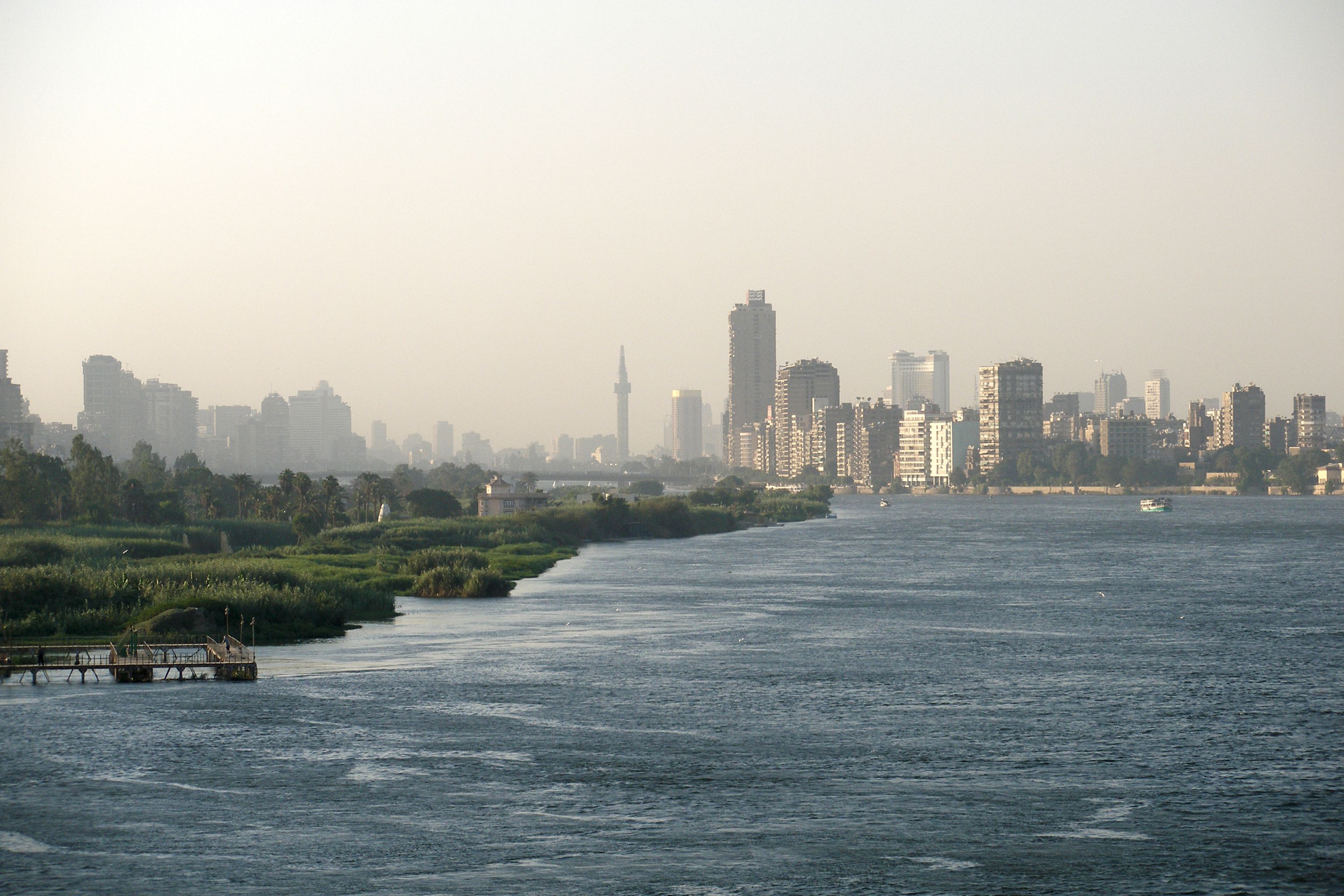
The Nile is a major north-flowing river in northeast Africa which empties into the Mediterranean Sea. At 7,088 kilometers (4,404 mi) long, it is the longest river in the world, although the volume of water it carries is much smaller than other major rivers such as the Amazon or the Congo. The Nile has played a central role in the environmental, economic, and cultural history of Africa for millennia.
The Nile has two major tributaries: the White Nile and the Blue Nile. The White Nile is longer and is considered to be the headwaters, yet the Blue Nile contributes over twice the volume of the White Nile. The White Nile begins near Lake Victoria and flows through Uganda and South Sudan; while the Blue Nile begins near Lake Tana in Ethiopia and flows into Sudan from the southeast. The two rivers meet at the Sudanese capital of Khartoum. From there, the Nile flows north through the Nubian Desert to Egypt's capital, Cairo, and finally empties into the Mediterranean Sea near Alexandria, where it has formed a large delta.
Geologically, the Nile is a young river and has followed its present course for about 15,000 years. Its drainage basin extends across eleven countries. Most of the water in the Nile comes from rainfall in the upstream countries Ethiopia, Kenya, Tanzania, and Uganda. Downstream countries – Egypt, Sudan, and South Sudan – are primarily desert, and withdraw river water for irrigation. Other countries that lie wholly or partly in the Nile Basin are Burundi, the Democratic Republic of the Congo, Eritrea, and Rwanda.
The Nile was the foundation of the Ancient Egyptian civilization, which relied on the river for nearly every aspect of life. The annual flooding of the river deposited nutrient-rich silt along the riverbanks. This soil supported crops that enabled a sophisticated society to thrive in an otherwise inhospitable desert. The Nile facilitated trade, communication, transportation, and governance. South of the second Nile cataract lies Nubia, the historical home of the ancient Kerma culture and the Kushite Empire. Many Europeans were fascinated by the Nile, and their explorations around Lake Victoria in the late 19th century located the source of the river. Among the cultures that live along the Nile in the modern era are the Nilotic peoples, semi-nomadic cattle herders who practice nomadic pastoralism, moving their cattle seasonally in response to the Nile's floods.
In the modern era, the Nile plays a critical role in the economies of Egypt and Sudan, which rely on it to irrigate extensive croplands. Since the late 20th century, over a dozen dams have been built in the Nile Basin to provide for irrigation and to generate electricity. The dams have altered the river's annual flood cycle and restricted the transport of silt downstream, causing the Nile Delta to shrink. Some dams – such as the Aswan High Dam and Grand Ethiopian Renaissance Dam – have been the source of international political disputes about water scarcity, safety, food security, and forced displacement of peoples.
General info from Wikipedia.org