Education in Jewish Daily Life
Education in Jewish life began with learning how to live within the family and community. Children learned practical skills and religious traditions. Some also received more formal instruction.


Jewish children learned in several ways. Much of their earliest learning happened within the family. Children listened to their parents, watched adults work, and gradually learned the skills and beliefs that shaped everyday life.
Some children also received more formal instruction. The evidence, however, does not support the idea that every Jewish child attended the same kind of school.
Education in the first century was broader than learning to read and write. Children needed to learn how to live within their families and communities.
The household was an important place of learning. Parents taught their children, and practical skills could be learned by watching experienced adults.
Scripture also had an important place in Jewish life. Children grew up hearing biblical teaching and taking part in the religious practices of their families.
Reading and writing were valuable skills, but literacy was not universal. Some people developed much greater ability with written texts than others.
Jewish communities also lived within a world where several languages were used. Aramaic and Hebrew were important, while Greek was widely present in the eastern Roman world.
Ancient Jewish sources show a strong interest in teaching the next generation. They also show that education could take different forms.
Some learning happened within families. Professional skills could be taught through work and training. More formal instruction was available in some settings.
The evidence does not allow us to describe one educational system that every Jewish child experienced.
The Bible places great responsibility on parents to teach their children. Deuteronomy describes God's words being taught during the ordinary activities of daily life.
Scripture itself therefore stood at the heart of Jewish learning. Its stories and commands helped shape the identity of each new generation.
The Gospels also show a world where Scripture was read, discussed, and remembered. Jesus frequently quotes Scripture and debates its meaning with others.
Understanding education helps us picture how knowledge was passed from one generation to the next in the world of Jesus.
It also protects us from a common mistake. We should not imagine a modern school system simply moved backward into first-century Galilee.
Jesus grew up within a Jewish world shaped by Scripture and family life. Understanding that setting gives useful background while leaving room for what the Gospels do not tell us about His childhood education.
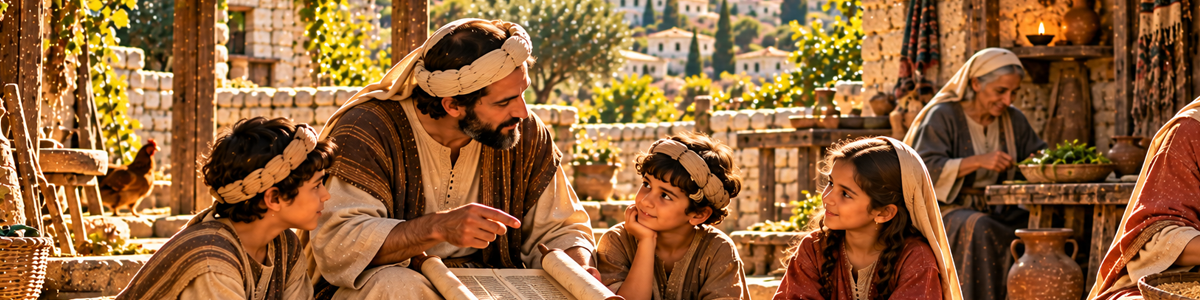
Education in Jewish life began with learning how to live within the family and community. Children learned practical skills and religious traditions. Some also received more formal instruction.
The home was one of the first places a child learned. Parents taught through words and example. Children also learned simply by sharing the everyday life of the household.
Much of a child's practical education happened by watching other people. Children saw adults work and gradually learned to help. Skills could be passed from one generation to the next through everyday experience.

Scripture stood at the heart of Jewish faith. Children could become familiar with its stories and teachings through family life and worship. Hearing was especially important in a world where not everyone could read a text for themselves.
Some people in Roman Palestine could read and write, but literacy was not universal. Ability also varied. A person might recognize or read some texts without having the skills of a trained scribe.
Writing was an important skill, but not everyone possessed it. People who could write well might prepare documents or copy texts. Some developed specialized skills as scribes.
People did not need to own a book in order to learn. Much information was heard rather than read. Listening and remembering were therefore important parts of learning in the ancient world.

Some learning took place through a direct relationship between a teacher and students. A teacher could explain a subject and answer questions. Students learned by listening and discussion.
Formal instruction existed in the first century, but it was not a universal experience. Some children received organized teaching while others learned mainly through family life and practical training.
Boys learned the skills and knowledge they would need as adult men. Much of this learning could happen within the family. Some boys also received more formal instruction.
Girls learned within the household and family just as boys did. Their education often prepared them for the responsibilities they would have as adult women. Some women also developed skills beyond ordinary household learning.

Many young people needed practical skills that would allow them to earn a living. A trade could be learned by working alongside someone who already knew the craft. Training often happened through practice rather than through books.

Roman Palestine was a multilingual place. Aramaic was commonly used among Jews, while Hebrew continued to have an important role. Greek was also present in the wider society.
Greek was an important language in the eastern Roman world. Jewish communities in Palestine lived alongside this Greek-speaking culture. Some Jews used Greek themselves, although ability varied from person to person.
© 2026 AVisitWithJesus
"For God so loved the world, that he gave his only begotten Son,
that whosoever believeth in him should not perish, but have everlasting life."
