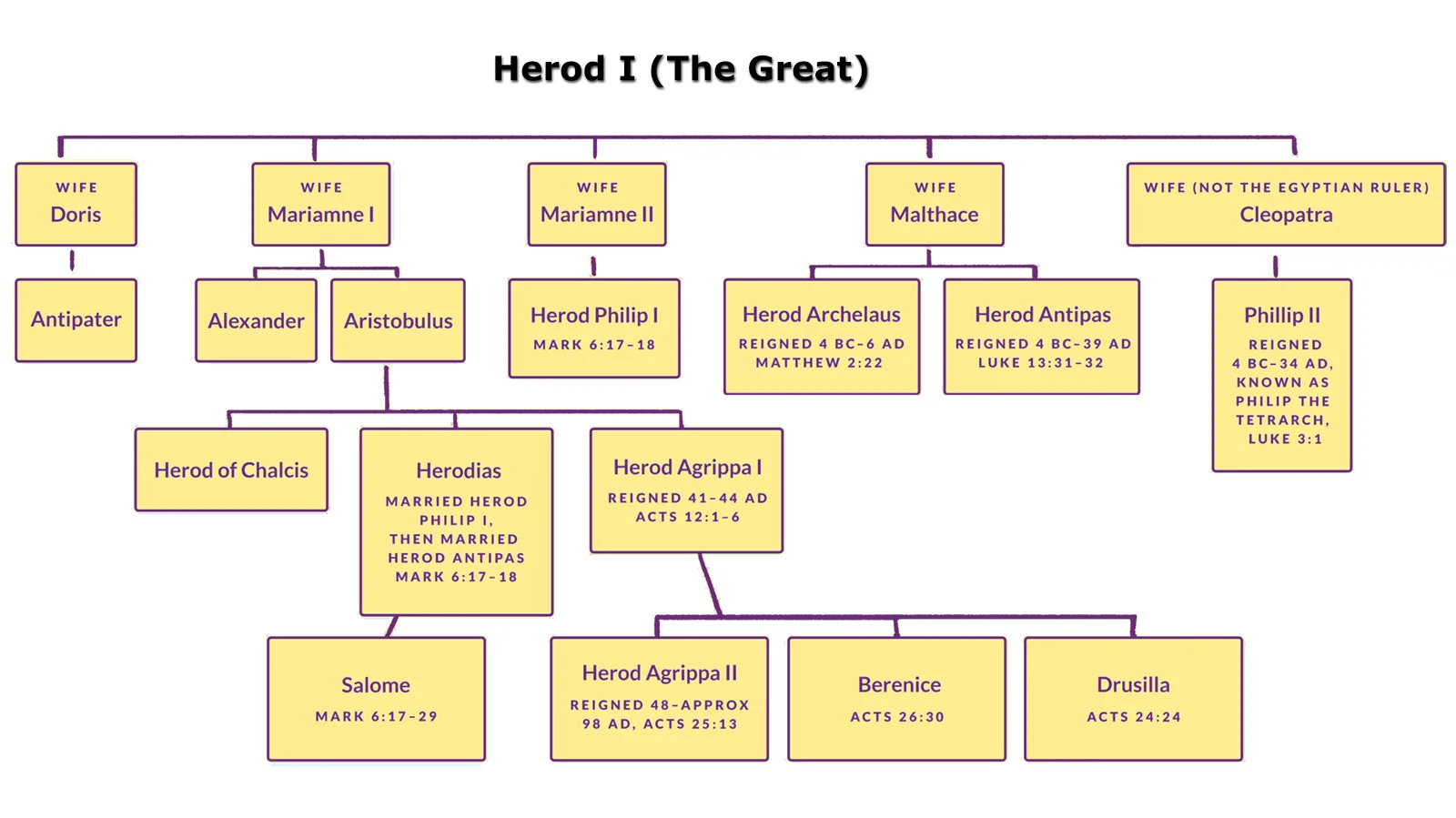
The granddaughter of Herod the Great, Herodias was first married to her uncle Herod II, ( Herod "Philip", but not Philip the Tetrarch- see below), with whom she lived in Rome and Judea. While on a visit to Rome, her brother-in-law Antipas fell in love with her and proposed marriage, to which she promptly agreed. leading the couple to divorce their spouses and marry each other.
Herodias was the daughter of Aristobulus IV, one of the two sons of Herod I (the Great) by the Hasmonean princess Mariamne I. She lived through the trauma of having her grandmother, her father, and several uncles killed by her grandfather. Herod I apparently retained some affection for Herodias herself, however. Her lineage on her mother's side gave her important credentials as a member of the Hasmonean line, seen by many Jews as far more legitimate than Herod's ancestry, as he was an Idumean by ancestry.
Herodias' mother, Berenice, was also of royal blood, being herself the daughter of Herod's sister Salome I, and of Costabarus, the governor of Idumea. Herodias' siblings included Herod III, king of Chalkis; Herod Agrippa the future king of Judea; Aristobulus V; and Mariamne III, who may have been the first wife of her uncle, Herod Archelaus, briefly the ethnarch of Judea.
Around the year 1 or 2 A.D., Herodias married her uncle, Herod II, also called Herod Boethus, a son of Herod the Great and Mariamne II. The Gospel of Mark calls Herod II "Philip," but this is probably an error, Philip being another son of Herod who was tetrarch of the territories east of the Sea of Galilee. Although seen for a while as the successor of Herod the Great, Herod II fell from grace after his mother was suspected of treason, and he was thus not included in Herod the Great's will as part of the plan to divide his kingdom among his other sons.
Herod II and Herodias nevertheless lived in luxury somewhere on the Mediterranean coast of the Levant as well as at Rome, where they enjoyed considerable influence. Herodias had a daughter, born around 14 C.E., whom she named Salome after her maternal grandmother.
Around AD 23, Herodias divorced Herod II and married another of her uncles, Herod Antipas, tetrarch of Galilee and Peraea. It is traditionally believed that Herod Antipas and Herodias truly loved each other, but political considerations were no doubt important considerations as well. Herodias' Hasmonean descent was a vital asset for Antipas' ambition to rise to the position of king and unite his lands with those of Judea. At the time, they were governed directly by the Romans after his brother Archelaeus proved incompetent. For Herodias, her marriage with Antipas improved her social status significantly and she was close to being a queen, a position she might have hoped for ever since her betrothal to her first husband when he was still the heir-apparent of Herod the Great.
For Hellenistic Jews the marriage may not have been extremely controversial. Some may have even had hopes in the restoration of a Jewish kingdom under Antipas and Herodias. The so-called "Herodians," referred to in the New Testament, may have been such a faction. However, the couple's union was not well received by some of Antipas' subjects, as it offended the religious sensibilities of strictly observant Jews. The marriage was interpreted by some as a violation of Jewish marriage law, which commands: "if a man shall take his brother's wife, it is an unclean thing; he hath uncovered his brother's nakedness." (Leviticus 20:21) Antipas was openly criticized by John the Baptist, who declared: "It is not lawful for you to have your brother's wife." (Mark 6:18) The criticism angered the couple enough that Antipas had the Baptist arrested.
In the Gospels of Mark and Matthew, Herodias plays a major role in the Baptist's execution, using her daughter's dance before Antipas and his guests to ask for the head of the Baptist as a reward. Mark 6 contends that Antipas did not want to put John the Baptist to death, both fearing his popularity and respecting his holiness. It adds that he enjoyed the Baptist's preaching. Matthew's account follows Mark in placing the blame squarely on Herodias.
The marriage to Herodias had important political advantages for Antipas, who was only the tetrarch of the Galilee. Because he lacked the noble Hasmonean lineage which Herodias possessed, gaining that would be to his advantage. However, their union raised tensions with the King Aretas of Nabatea, Antipas' neighbor state. It was the daughter of Aretas who had been the tetrach's first wife before Antipas divorced her.
In 37 A.D., with the accession of Caligula to the imperial throne, Herodias' brother Agrippa I was made king over the eastern territories of Batanaea and Trachonitis. Previously, Herodias had intervened with emperor Tiberius on Agrippa's behalf and secured financial assistance for him from Antipas. However, Agrippa later quarreled with Antipas and parted from Herodias on less then friendly terms. Herodias now pushed Antipas to travel to Rome and ask for the title of king from the the new emperor, Caligula. However, they were outsmarted by Agrippa, who had sent letters to Caligula denouncing Antipas' alliance with Parthia and alleging that he was stockpiling weapons for a rebellion. Caligula deposed Antipas and sentenced him to exile, probably in what is now Lyon (Gaul). Although the emperor offered Herodias the right to return in Judea to live at the court of her brother, she refused the offer and accompanied her husband into exile. She probably died shortly afterward.